Digital Art Design: articles, books, 2d/3d software observations, tutorials & 3d art fantasy gallery features.
 3-D or 3D abbreviates "three dimensional" and is often related to a stereoscopic display that exploits binocular vision. 3-D or 3D abbreviates "three dimensional" and is often related to a stereoscopic display that exploits binocular vision.
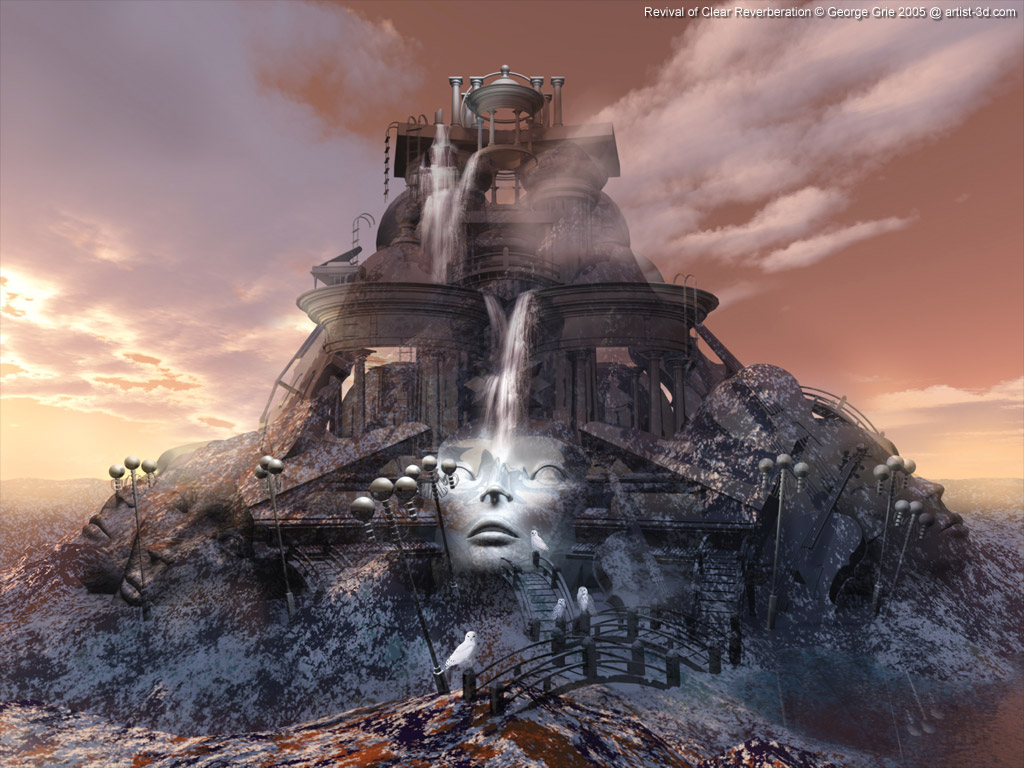
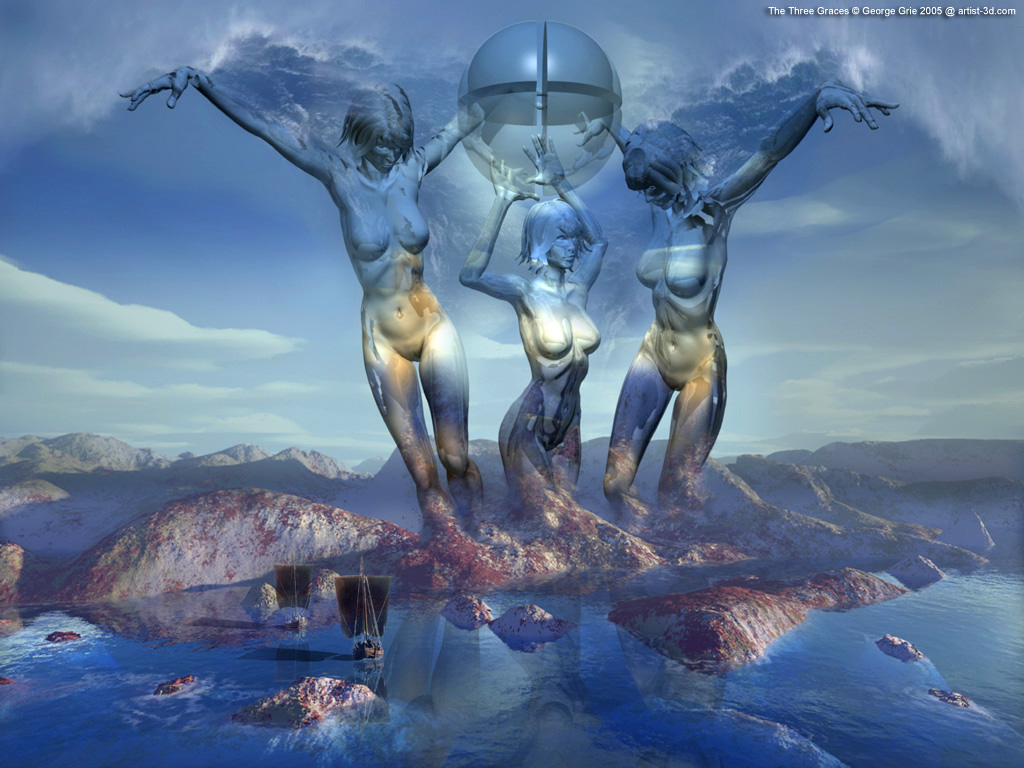
Intoduction: Welcome to the 3d art reality. I'm confident that new graphic technologies unlocked endless possibilities to creative individuals. Visual capabilities of some contemporary 3d graphic applications are far beyond common human comprehension. Today the sky is the limit to exercise your imagination, intelligence, and ambitions. "Everything is possible" could be a motto of present and future digital artists. I'm trying to prove it in every one of my modest creations. Never-ending combinations of renderings, lightings, and/or shape deformations bring you the sensation of full liberty. There are no more hours of a laborious painting routine.
There is no more painful drafting. Everything is instant under the tips of your flying fingers. There is only one chilling obstacle between you and your perfect design - lack of imagination. The new form of art was born without pompous manifestations and noisy commercials. Some of us still consider digital and 3d art as something mechanical and artificial, something that in some way is out of human touch. Nothing could be more wrong. Computers don't make art, people do. A Computer is a creative tool a much sophisticated one. Once you try them you will never give up going forward. It's a fresh creative drug of a new generation of an artistic society. It's an addiction with no cure. It is a curse you can't get rid off. It's your blessing destiny.
George Grie - 3d artist
Three dimensional objects have volume and may be measured and described using three orthogonal directions. In animation, 3-D sometimes refers to shaded, modeled shapes that have an appearance of depth, as opposed to the "flat" rendering of conventional cel animation. An example of this was seen in a particular episode of the animated video cartoon The Simpsons, where Homer escapes his flatland-like world and enters a universe of higher dimensionality. The figure renderings and visual effects in this episode were accomplished using 3D computer graphics. In literary criticism rounded three dimensional characters are contrasted to cardboard cutouts. 3D computer graphics are works of graphic art that were created with the aid of digital computers and specialized 3D software. In general, the term may also refer to the process of creating such graphics, or the field of study of 3D computer graphic techniques and its related technology.
3D computer graphics are distinct from 2D computer graphics in that a three-dimensional virtual representation of objects is stored in the computer for the purposes of performing calculations and rendering images. In general, the art of 3D graphics is akin to sculpting or photography, while the art of 2D graphics is analogous to painting. In computer graphics software, this distinction is occasionally blurred; some 2D applications use 3D techniques to achieve certain effects such as lighting, while some primarily 3D applications make use of 2D visual techniques. Creation of 3D computer graphics The process of creating 3D computer graphics can be sequentially divided into three basic phases: Computer 3d Wallpapers are desktop backgrounds set by a users preference. Most operating systems come with a default selection of wallpapers, but also have features to enable the user to set or assign their own. History Computer wallpapers started with the release of Windows 95, which was an upgrade from Windows 3.1. It was then seen as a feature on many other platforms including Unix GUI's (Gnome, KDE) and Mac OS. |
Possible keyword strings: Fantasy Art 3D Wallpapers: digital art free modern pictures artists images. 3d art wallpaper, dark fantasy arts pictures 3d free wallpapers digital gallery. 3d digital fantasy art, pop arts pictures 3d landscape wallpaper web gallery. 3d fantasy arts work, beautiful art pictures 3d wallpaper download surrealism artworks. |
Digital art is art created on a computer in digital form. Digital art can be purely computer-generated, such as fractals, or taken from another source, such as a scanned photograph, or an image drawn using vector graphics software using a mouse or graphics tablet. The term is usually reserved for art that has been non-trivially modifed by the computer; digitized text data and raw audio and video recordings are not usually considered digital art in themselves, but can be part of a larger project. The availability and popularity of photograph manipulation software has spawned a vast and creative library of highly modified images, many bearing little or no hint of the original image. Using electronic versions of brushes, filters and enlargers, these "Neographers" produce images unattainable through conventional photographic tools. In addition, digital artists may manipulate scanned drawings, paintings, collages or lithographs, as well as using any of the above-mentioned techniques in combination. Artists also use many other sources of information and programs to create their work. links
3D graphics are created via the process of designing complex imagery from geometric shapes, polygons or nurbs to create realistic 3 dimensional shapes, objects and scenes for use in various media such as film, television, print and special visual effects. There are many software programmes for doing this. The mainstream media uses a lot of digital art in advertisements, and computers are used extensively in film to produce special effects. Desktop publishing has had a huge impact on the publishing world, although that is more related to graphic design. Anai - digital art (portrait) detail, 2005Nonetheless, digital art is yet to gain the acceptance and regard reserved for "serious" artforms such as sculpture, painting and drawing, perhaps due to the erroneous impression of many that "the computer does it for you" and the suggestion that the image created could be infinitly repeatable. Computers are also commonly used to make music, especially electronic music, since they present an easy and powerful way to arrange and create sound samples. It is possible that general acceptance of the value of digital art will progress in much the same way as the increased acceptance of electronically produced music over the last three decades. Some say we are now in a postdigital era, where digital technologies are no longer a novelty in the art world, and "the medium is no longer the message."
|
|